Luxury brands have spent many decades building their unique position in the market, forming deep connections with generations of clients. That is every business's dream. But from a digital perspective, a long legacy often also means legacy technology, and data that's locked into internal system silos. That is a killer for digital innovation, and a road block for digital teams that need to move at the speed their clients expect.
We have spoken with experts in the luxury industry and worked with world-class luxury brands such as Cartier. This article brings together what we've learned.
What luxury clients expect from digital
Luxury is all about beauty, craftsmanship, and exclusivity. Luxury consumers still expect to shop in an exclusive way, but they are doing more of this online.
Luxury clients have a higher expectation of availability and transparency. They demand more information upfront, and they want access to the products through more sales channels. And a younger, more digitally connected generation of clients will not stand in line in a physical store for a product. They'll just look for another brand.
The world of luxury is also closely linked to anticipation: the excitement a brand manages to create, and the anticipation of a client's needs.
In the online world, luxury is the promise of a truly frictionless, and exceptional customer experience.
So brands must create a strong digital experience that embodies their brand, where clients are unable to feel, touch and taste the product without being in the store. And the digital experience cannot differ from the heritage, because the heritage is the competitive edge.
Three key digital trends for luxury brands
Thaïs Montjean highlighted trends that are key both for business and for brand building:
- Omnichannel re-orchestration. Omnichannel commerce is not a trend per se, but a fundamental pillar brands will always focus on. Customers are more and more comfortable with digital services, and luxury brands need to increase their agility and adaptability, and make sure they can deliver digital products fast enough.
- Clienteling and hyper personalisation. Luxury is about frictionless delivery and experience, so brands must continuously offer the latest and most efficient services: hyper personalisation, live chat, virtual appointments and other sophisticated services.
- Sustainability and recommerce. Customers increasingly favour brands with a commitment to environmental sustainability, so brands need to give more visibility to information on materials, sourcing and environmental impact, especially content that shows their actual actions. Recommerce, the commerce of previously owned products, is also a growing market opportunity. The coming Digital Product Passport will make this kind of product information a requirement.
Four challenges for luxury brands
You are serving the most demanding customers in the world. They expect a high-end experience, and they wish to feel like they are getting something extra from your brand. These are the four challenges we see time and time again:
- Reinventing classic products and how you bring them to market. Luxury brands have products that have remained classics for decades, and they don't launch new products with the same frequency as other industries. They need to wow their clients with the experience around the products.
- Laying digital on top of the boutique experience. The concierge experience in the boutique needs to be supported with digital tools.
- Retaining global relevance amongst more diverse client segments, who interact with the brand in many different locations.
- Keeping up with modern changes in CX and digital, whilst always respecting the brand heritage.
Why legacy tech holds digital teams back
The biggest problem is that data cannot flow seamlessly across channels in real time, because the technology stack is dated and built in silos.
Systems have typically been bought or built for a very specific purpose: ERP for transactional and stock data, PIM for product information, CRM for customer data. They are built for backend processes to create and store data, not to combine and activate the data in a customer-facing experience. And that is where you create the biggest business value.
With that setup, every time you want to build a new digital experience you need to build new integrations from the ground up, which can take 6, 12 or 18 months. In the end, you're left with a monster of point-to-point integrations that are costly to maintain, under a constant threat of breaking, and unable to scale.
How product orchestration helps luxury brands move faster
Occtoo's Product Orchestration Engine replaces the PIM and connects the other systems you already have. It unifies product, customer and transactional data in one place and makes it available in real time to any channel or frontend, on a global scale. That has four benefits that are especially relevant for luxury brands.
1. Digital teams become data autonomous
Data is the fuel for great digital experiences. When digital teams always have the data they need at their fingertips, they no longer depend on internal or external tech resources for every new initiative. That is a massive game-changer in how fast they can go from idea to deployment, and it unleashes creativity. Your team spends more time and energy on creative execution instead of integration.
2. Reinvent how products are brought to market
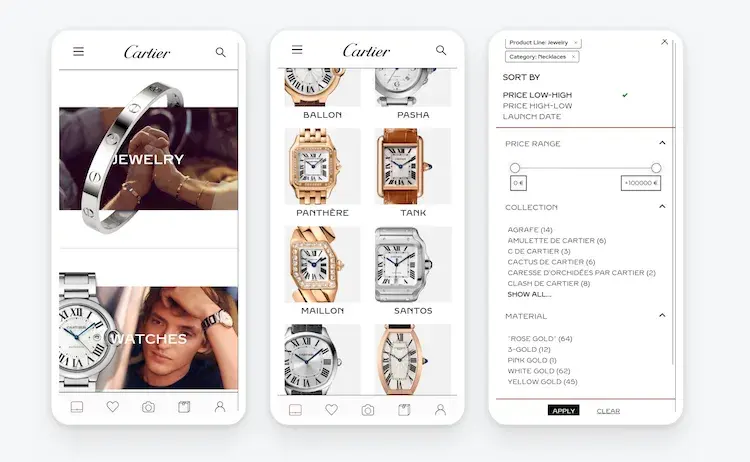
With easy access to data, you can create digital experiences around the moments that matter to clients. Cartier's bridal app is one example: the future bride and groom browse the global assortment and get a guided journey through everything to think about when choosing a wedding ring. Built the traditional way, every new initiative like this means building the integrations all over again.
3. Layer digital on top of the boutique experience
Cartier built an in-store app that gives sales associates product information at their fingertips, so they can move freely around the store with the client and answer any question, instead of going to a desk and searching a system that took ages to load. The app went from idea to MVP in 30 days.
4. Scale digital experiences globally
Luxury clients are citizens of the world. With all data unified and available in real time, the same seamless experience can be offered to clients and employees whether they are in Buenos Aires, Tokyo or New York.
And you can do it without rebuilding your whole stack. Occtoo replaces your PIM, and systems like ERP and CRM become even more valuable, because you can finally combine and activate their data.
Cartier launches new experiences 4x faster
Cartier unifies its data in Occtoo and has launched a handful of new digital experiences in the form of apps and mini-sites, for both clients and employees.
We are doing a lot of creative innovation that requires data. If we had built experiences the traditional way our time to market would be at least 4x slower.
Read the full Cartier customer story, see everything Cartier has built with Occtoo, or watch the webinar How Cartier transformed their digital capabilities.
In summary
Digital experience for luxury brands no longer needs to mean a lack of service, personalisation and exclusivity. Nor should digital experience be restricted to e-commerce. For luxury brands to succeed in digital, they must find a way to create a unique experience, laced with the heritage and beauty their brand is renowned for. Once that experience is defined, it becomes a matter of how you unify and activate the data for a true omnichannel journey.
Want to see how it could work for your brand? Book an intro.