Most companies treat product data as an operational problem. Something to manage, maintain, and fix. It's the cost of doing business. That framing is costing them more than they know.
Product data infrastructure is not an operational problem. It is a growth constraint. The way your product data is structured, connected, and activated determines how fast your business can move - how quickly you can launch, how many destinations you can reach, and whether your products show up when AI agents go looking.
Get it right, and you remove the ceiling. Get it wrong, and you spend your time banging your head.
The ceiling nobody talks about
Every company has a product data story that goes something like this:
A new channel opportunity arrives: a B2B portal, a smart device, a new market, an AI Agent that needs TLC. The team is ready. The product is right. But the data is not. It lives in four different systems. It does not map cleanly to the new format. Someone has to translate, fix, and rebuild before anything can launch.
Weeks become months. The opportunity shrinks. A competitor gets there first.
Or a brand new huge campaign needs to go live. The merchandiser needs to pull data from three systems, reconcile inconsistencies, and wait for IT to configure the feed. By the time everything is ready, the moment has passed. Ops.
What fragmented product data costs
When companies calculate the cost of their product data setup, they rarely have the entire picture. What they miss:
Every integration project. Every new destination, every new system, every new data source requires an integration project. Weeks of IT time, development budget, and project management, for something that should take days. Multiply that by every initiative in the roadmap.
The IT bottleneck. Category managers, merchandisers, and ecommerce teams all need to act on product data. When the infrastructure is not built to empower them, every change goes through IT. The backlog grows. The business slows.
Duplicate tools. When one system cannot do everything, organisations add another. Then another. Each tool solves a slice of the problem and adds its own integration overhead. The total cost of ownership compounds quietly.
Delayed launches. Every day a product is not live is a day it is not generating revenue. When product data infrastructure is the bottleneck, that delay is systematic.
AI readiness debt. AI agents and AI-powered search are already evaluating and recommending products. They need complete, structured, machine-readable Master Product data to do it. Fragmented product data does not just slow your team down. In agentic commerce, the era where AI agents search, evaluate, and purchase on behalf of buyers, it makes your products invisible.
Nelly.com understood this. Before restructuring their product data infrastructure around Occtoo, their IT team numbered around 20 people — most of them keeping the complexity running, not building for the future. After: only 4. The rest of the business got faster. New initiatives that previously took months could be tackled in days. The infrastructure stopped being overhead and started being an engine.
The infrastructure ceiling in practice
You know you have hit the ceiling when:
- Adding a new destination requires a project, not a configuration
- Getting a product live takes days when it should take hours
- Your teams are waiting on IT for data they should access themselves
- Your product data is not complete enough to feed an AI agent confidently
What the right infrastructure makes possible
The companies moving fastest on launches, new destinations, and AI readiness have one thing in common: their product data infrastructure is not a constraint.
They use a Product Orchestration Engine — a layer that sits between their data sources and their destinations. It connects to wherever product data lives: ERPs, PIMs, supplier feeds, and marketing tools. It builds the complete Master Product: the single, trusted view of everything needed to make a product sellable anywhere. And it activates that data to any destination, any team, any AI agent. In real time. Without a project.
The outcome? Speed that compounds.
New integrations that used to take months take days. Alligo moved product data activation from days to hours, and new use cases that previously required months of work can now be enabled in days. Nelly.com replaced their entire commerce stack in six months and reduced IT complexity by 80%. Nordic Nest shortened lead times, launched more products, and maintained their highest quality standards.
"With Occtoo, we've been able to consolidate complex data sets, avoid data silos, reduce unnecessary storage, and build an efficient information architecture."
Emil Björkman, Enterprise Architect, Fenix Outdoor
Infrastructure is strategy
The companies that will win the next phase of commerce are not the ones with the biggest budgets or the boldest AI strategies. They are the ones whose product data infrastructure can keep up with what they are trying to do.
AI agents need complete, structured Master Product data to discover and recommend products. New destinations need data that is ready, not data that needs three months of preparation. Teams need to move without waiting on anyone.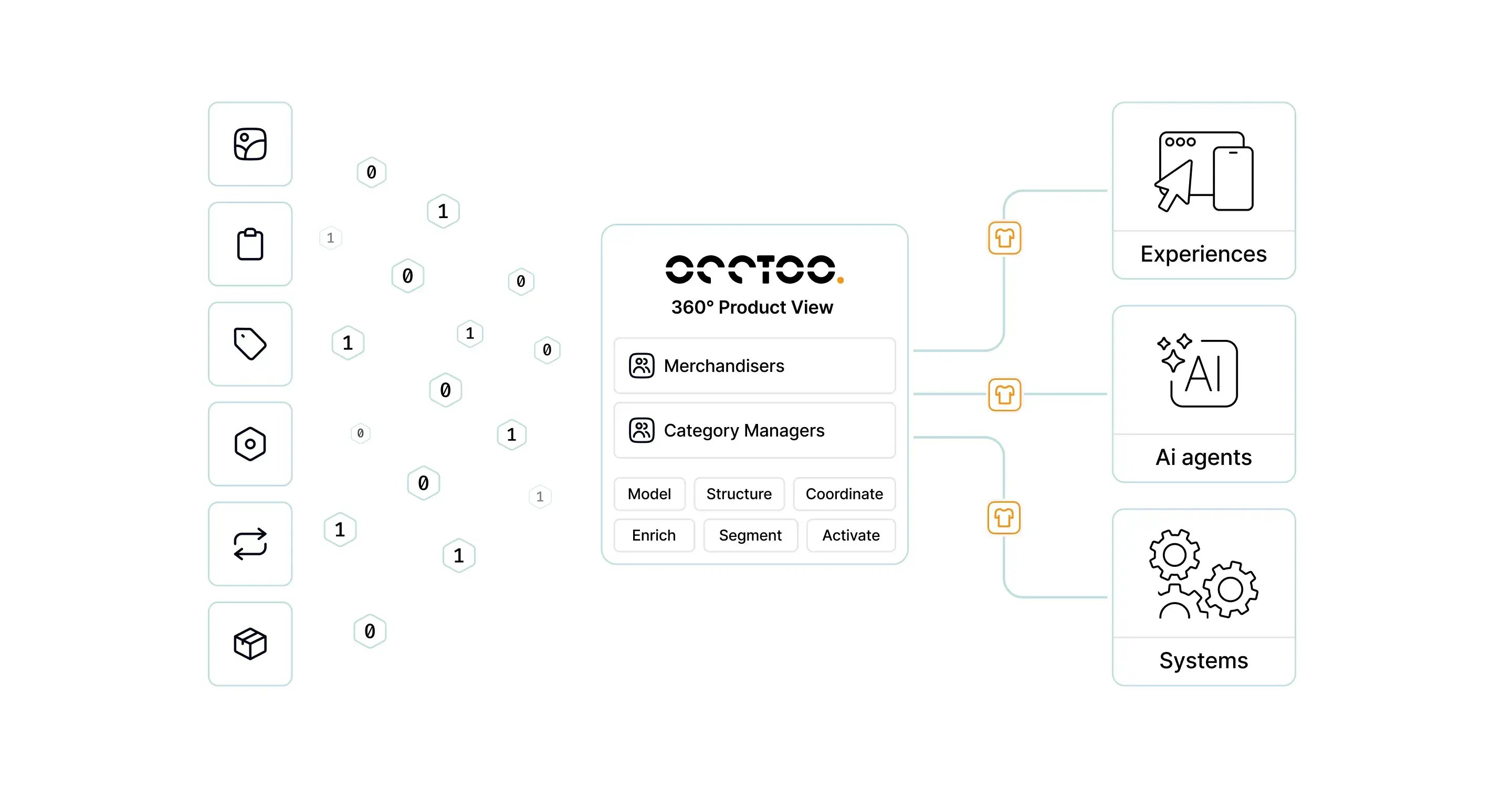
Your product data infrastructure is either an accelerator or a ceiling. Right now, for most companies, it is a ceiling.
Think you need a better data setup? Think bigger than PIM.
Book a 20-minute intro call to see what product orchestration looks like in practice.