Every ERP implementation starts with a reasonable premise: one system, one source of truth, everything connected. It's a good premise for finance. But it's the wrong premise for commerce.
Commerce doesn't want one static source of truth. It wants product data and offerings that's different for every channel and customer, updating in real time. It wants orders that move at the speed of a viral TikTok moment, not the speed of an overnight batch job.
However, many retailers still bet on ERP to run their commerce operations. Their reality is filled with six-figure ERP customizations just to get product data and order flows to behave like commerce instead of accounting, IT teams stretched thin maintaining integrations that break every time a new channel launch and CTOs challenged by the commerce colleagues because they can't deliver with a system built for ledgers.
So what do they do? What they always have done: add modules. They customize workflows, bolt on a PIM for the content problem, hope the order management module keeps up, and call the result "digital transformation." Three years later, the same conversation starts again.
This, fellow industry friends, is a repetitive architecture problem that needs to stop. There is a better way.

Why every fix or add-on module has failed
The reason the fix never sticks is simple: the ERP is being asked to do two jobs it was never designed for.
Product data in commerce is not a record. It's a living thing. It needs to be different for every channel, every market, every customer context, assembled in real time, activated everywhere, updated without a sync job. No ERP module does that. No PIM bolted onto an ERP does that either.
Order data in commerce is not a transaction log. It needs to know, in real time, where stock lives, which warehouse is closest, which fulfilment route is fastest. It needs to react in seconds. No order management module wedged into a financial system does that.
The result is always the same: two critical functions running on infrastructure that tolerates them instead of enabling them.
How did commerce end up on a system built for accounting? And what do we do about it?
Retailers didn't build commerce on their ERP because it was good at commerce. They built on it because there was nowhere else to go.
There's somewhere else to go now.
Product data belongs in an orchestration layer. Order data belongs in a dedicated OMS. Neither belongs in a system built for ledgers and reconciliation.
That's not a feature update. That's not a new module. That's the architecture that finally lets commerce run on infrastructure built for it from the start.
The architecture that ends the fixing cycle
The fix isn't a better ERP. It's taking the two things that drive revenue, product data and order data, out of the ERP entirely, and giving each one an architecture built specifically for the job.
Product data belongs in an orchestration layer. One that connects to every source, assembles the complete, contextual product in real time, and activates it everywhere commerce happens. Website. B2B portal. Marketplace. AI agent. Every channel gets exactly what it needs, from a single source that's always current.
Order data belongs in a dedicated order management system. One that handles cart, checkout, fulfilment, and inventory at the speed modern commerce demands. That knows the second a size sells out in one warehouse and instantly routes to the next, without waiting on a sync.
Put these two together and something happens that no ERP extension ever delivered: the ERP finally gets to stop pretending. It goes back to what it was always meant to be — accounting, payroll, procurement — lean and unbothered, while product data and order data run on infrastructure built for commerce from day one.
This is what Occtoo and Omnium are built for
Occtoo builds the Master Product (the single, unified source of everything that makes a product sellable across any channel: pricing, inventory, supplier data, and rich media). Not a database you import data into, a live orchestration layer that assembles and activates product data across every channel and every agent, in real time.
Omnium builds the Master Order. A dedicated OMS that handles the full order lifecycle at the speed modern commerce demands.
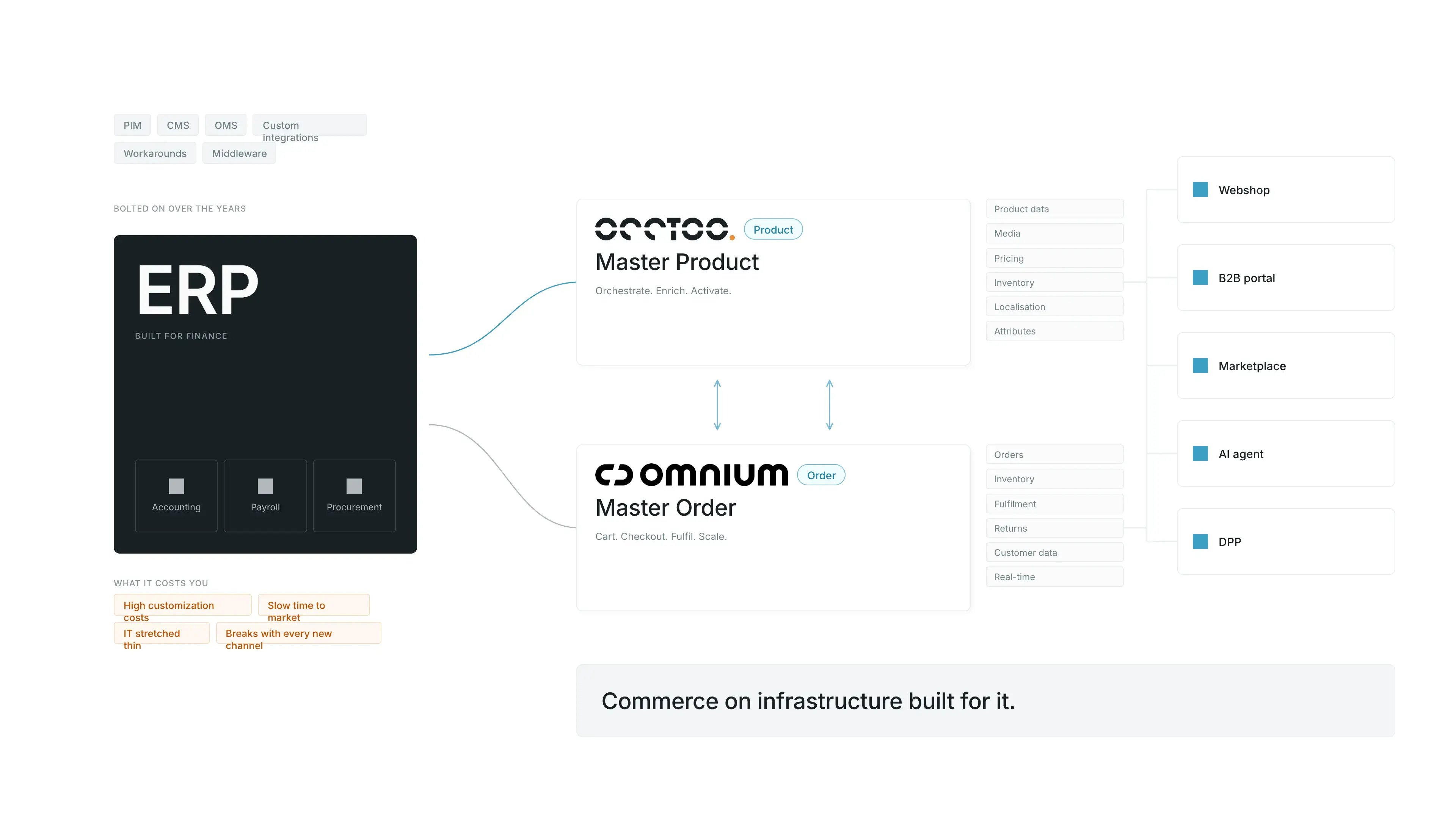
Pre-integrated, these two systems solve both halves of the revenue problem at once. No re-platforming. No new logo doing 10% of the job. A structural fix, built once, for the two things commerce runs on.
What changes when product data and order data work together
Launching a new channel stops being a development sprint. Product data is already orchestrated and ready to activate. Order flows are already built for real-time complexity. You're configuring an endpoint on both sides, not commissioning two separate integration projects that have to be kept in sync forever.
Your ERP stops being the excuse in every planning meeting, because it's no longer being asked to do two jobs it was never designed for.
And the re-platforming conversation, the one that comes back every three to five years because the last fix only solved half the problem, stops being necessary. Because this time both halves got fixed at once.
Book an intro
If you are having the same architecture conversation for the third time, it is probably the right time to change the answer. Book an intro call and let us show you what product data built for commerce can look like.