I've spent more than two decades in the product data space. Long enough to remember when the biggest challenge wasn't real-time APIs or omnichannel orchestration. It was just getting product content into a printed catalogue before the print deadline. That was the problem PIM was invented to solve. And it solved it well.
But here's what nobody in the category wants to admit: most of what calls itself PIM today is still solving that same problem. The vendors have rebranded. The interfaces look sleeker. Everyone's added AI features. But the core assumption, that product data management is fundamentally a content publishing problem, hasn't changed.
The world moved. PIM didn't.
The category called PIM is three different things
When companies go looking for a product data tool, they enter a category built on three completely different foundations, from three completely different eras of commerce. Understanding the difference is not a technical question. It is a tactical and strategic one.
Type one: The traditional PIM
The original PIM was born from a simple need. Print catalogues were giving way to digital storefronts. Product data needed to live somewhere that wasn't the ERP, which was, and still is, a system built for finance and logistics, not product storytelling.
It worked. For that era, it was exactly the right tool.
The problem is that the traditional PIM was built to administer product content, not to activate Master Product Data. Administration means managing what you hold. Activation means making your data available to whatever needs it, in real-time, without an integration project every time.
Not the full picture of the product
There's something else worth saying. The data that a traditional PIM holds is not the full picture of a product. Pricing lives in the ERP. Inventory in the OMS. Sustainability attributes, delivery times, weight, and dimensions are scattered across systems that nobody has joined together. The traditional PIM holds one slice. The rest exists somewhere else, waiting to be stitched together manually every time the full Master Product is needed.
That's not a criticism. It's a description of what these tools were designed to do, in a world that no longer exists.
Type two: The “new” lightweight tools
Over the last few years, a new category has emerged, leaning heavily on LLMs. These tools solve a real problem: product content quality. Incomplete descriptions. Inconsistent attributes. Copy that doesn't convert. For a B2C brand or smaller retailer, they offer something genuinely useful.
But that's also where they stop.
Wrapped around an LLM
The AI in most of these tools is a wrapper around a large language model. Feed it your attributes, get better copy back. Useful, but not the same as having structured, complete, machine-readable product data ready for what commerce is becoming.
They manage what shows up on the product detail page. They are not built to handle the Master Product: the complete, unified view of everything a product needs to be sellable anywhere. Pricing. Inventory. Supplier data. Certifications. The full picture a complex retail or B2B operation runs on.
For the right company at the right scale, this is a reasonable tactical choice. But they don't address the underlying data logistics challenge.
Type three: The Product Orchestration Engine
The third type of tool is built on a completely different foundation. Not content administration. Not lightweight copy generation. Data logistics.
The distinction matters more than it might sound. A system built for data logistics is designed to connect to wherever data lives, move it reliably, transform it into whatever shape is needed downstream, and make it available to any destination in real time, without a custom integration every time. It's built to handle volume, complexity, and change, because commerce is all three.
This is what Occtoo is built for. Product Orchestration is not a feature we added to a catalogue tool. It is the foundation on which we built everything.
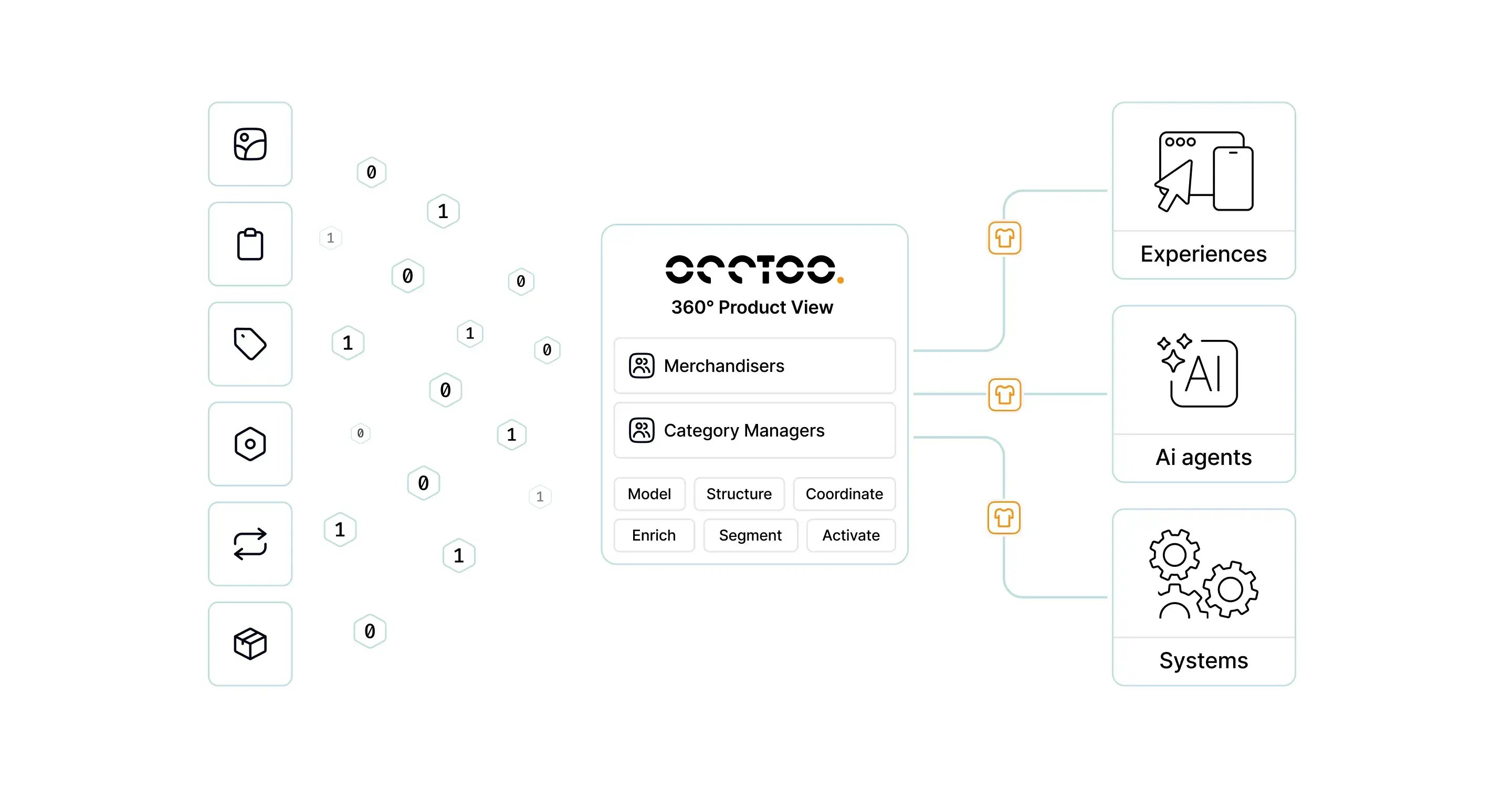
What that means in practice: we connect to your ERP, your PIM, your supplier feeds, your DAM, your marketing tools. We pull it all together and enrich it — structuring, validating, and completing the data until it becomes the Master Product: the single, complete, trusted view of everything required to make a product sellable anywhere.
Then we activate that data to any destination: your website, your B2B portal, your mobile app, your smart devices, your AI agents. Without a six-month integration project. Without waiting on IT every time something changes. Connect your preferred LLM, switch models per feature, set it up once, and let it work across the entire workflow.
The traditional PIM holds a slice of your Master Product. The lightweight tools rely heavily on LLMs to fill the gaps. The Product Orchestration Engine ensures that every part of the business and every AI agent can work with the complete Master Product from a single place.
Why this matters right now
AI agents are already searching, comparing, and recommending products. These agents read structured data. They evaluate signals: attributes, certifications, usage scenarios, sustainability context, pricing, and availability. If any of that is missing, the agent can't make a confident recommendation. Your product becomes invisible.
That's the new cost of having fragmented product data. Not just slower launches and more manual work, though those are real. The cost is invisibility in the buying process that's already replacing the one you built your operations around.
A lightweight content tool won't fix that. A traditional PIM won't fix that. The foundation has to be right.
The question worth asking
When your organisation starts looking at product data tools, the first question is usually "which PIM should we buy?" It's the wrong question.
The right question is: what does your product data need to do?
If the answer is "get better product descriptions faster", there are lightweight tools built for that.
If the answer is "manage and enrich structured attributes for our existing channels", a traditional PIM might still serve you well.
But if your product data needs to connect everything, build a complete Master Product, and activate it to every channel and every AI agent, then you are not looking for a better PIM. You are looking for something built for an entirely different era of commerce. You are looking for a Product Orchestration Engine.
Book a 20-minute intro call to see what product orchestration looks like in practice.