We’re not saying PIMs are no longer useful. But as the need for product data grows and agentic commerce knocks on the door, the limited data stored in a PIM solution is no longer enough. Consumers and partners want more, and it needs to be easy for you and your team to deliver.
What is product information management (PIM)?
Product information management, or PIM, is the practice of centralising and managing structured product data — names, descriptions, attributes, specifications — in a single system. A PIM makes it easier to keep product content consistent and distribute it to sales channels.
PIM systems became essential in the early days of ecommerce, when the challenge was simply getting product attributes into one place and pushing them to a website or catalogue. For that purpose, they worked well.
The problem is that product data has moved far beyond structured attributes. And the world your customers shop in has too.
The master product stretch
Think of your master product as a T-shirt stretched across all the systems that hold product data. Over time, that T-shirt gets pulled in too many directions. Eventually, it tears, and suddenly you have holes everywhere. That’s exactly what happens to your master product data. There are gaps all over it. 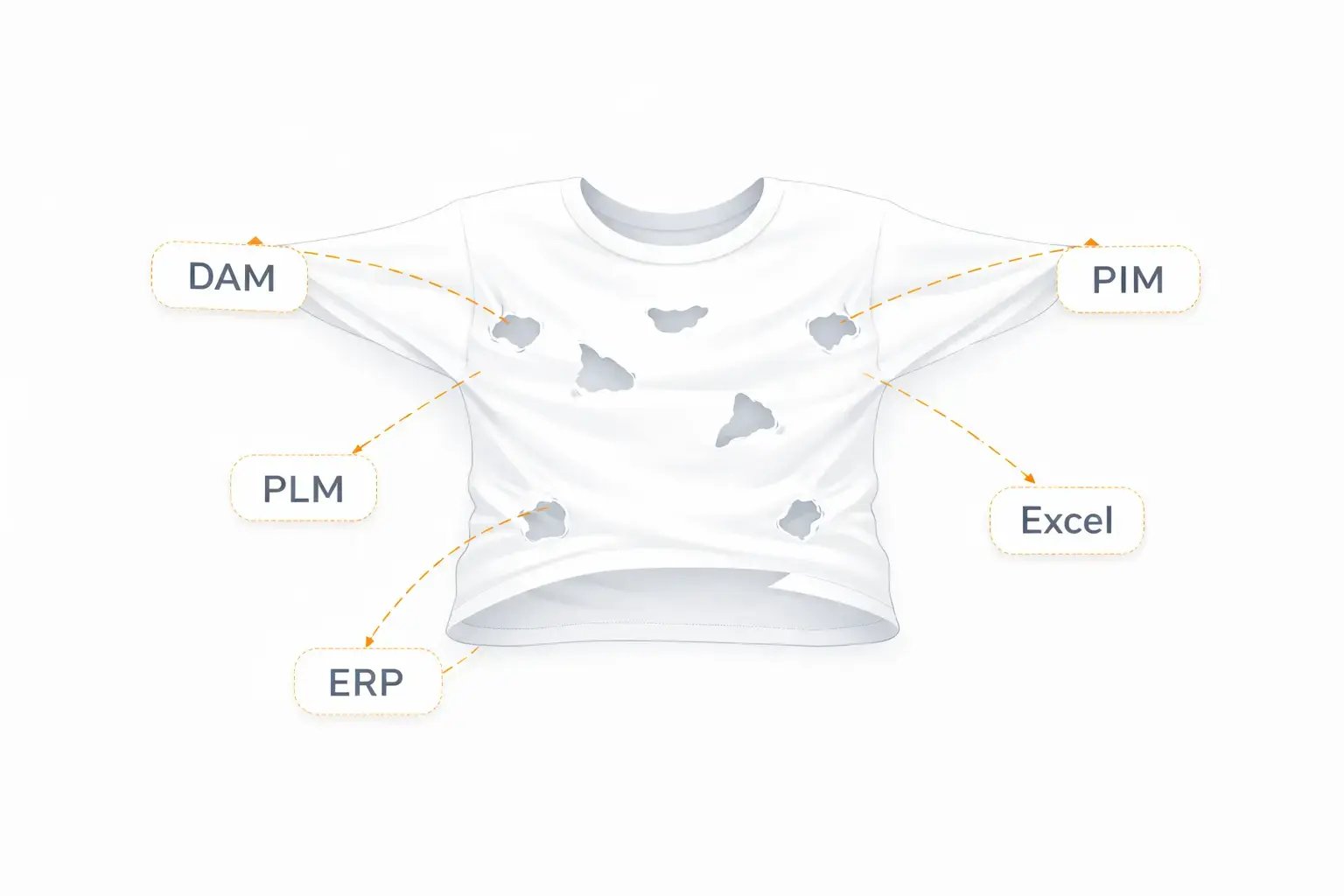
Product data lives everywhere. To get a complete view of your master product, most organizations have to go on a scavenger hunt across multiple systems. Some data lives in the DAM, some in the PIM, some in the PLM, a lot in Excel spreadsheets, and transactional data in the ERP. The result is a fragmented product truth and teams stitching pieces together for the perfect product data feed.
To deliver complete, accurate product feeds that flow directly into PDPs, experiences, AI agents, and every other touchpoint, you need to start orchestrating your product data. Not simply managing it in silos.
What is product data management in the age of AI?
AI agents do not browse product pages. They read structured data. They interpret, compare, and filter based on signals: attributes, certifications, usage scenarios, sustainability context, pricing. If any of those signals are missing or inconsistent, the agent cannot confidently recommend or purchase your product.
This changes what product data management needs to do. It is no longer enough to store attributes in one place and push them to a website. Product data management today means building a complete, trusted, machine-readable master product, and keeping it current across every system, channel, and AI endpoint.
That is what product orchestration is built for.
What is the Master Product?
The Master Product is the single, unified view of everything needed to make a product sellable across any channel.
It brings together:
- Structured attributes and descriptions
- Media and brand assets
- Pricing and logistics data
- Supplier and sourcing information
- Transactional and behavioural data
- Sustainability attributes and certifications
- Usage scenarios and contextual content
Without a Master Product, teams are always assembling. With one, every channel, including AI agents, pulls from a single trusted source.
What’s the difference between a PIM and a product orchestration engine?
All product data / your master product / the 360-product view
With Occtoo’s Product Orchestration Engine, you orchestrate all your product data in one place: descriptions, media, supplier data, customer data, and transactional data.
Unify, enrich and activate across every channel.
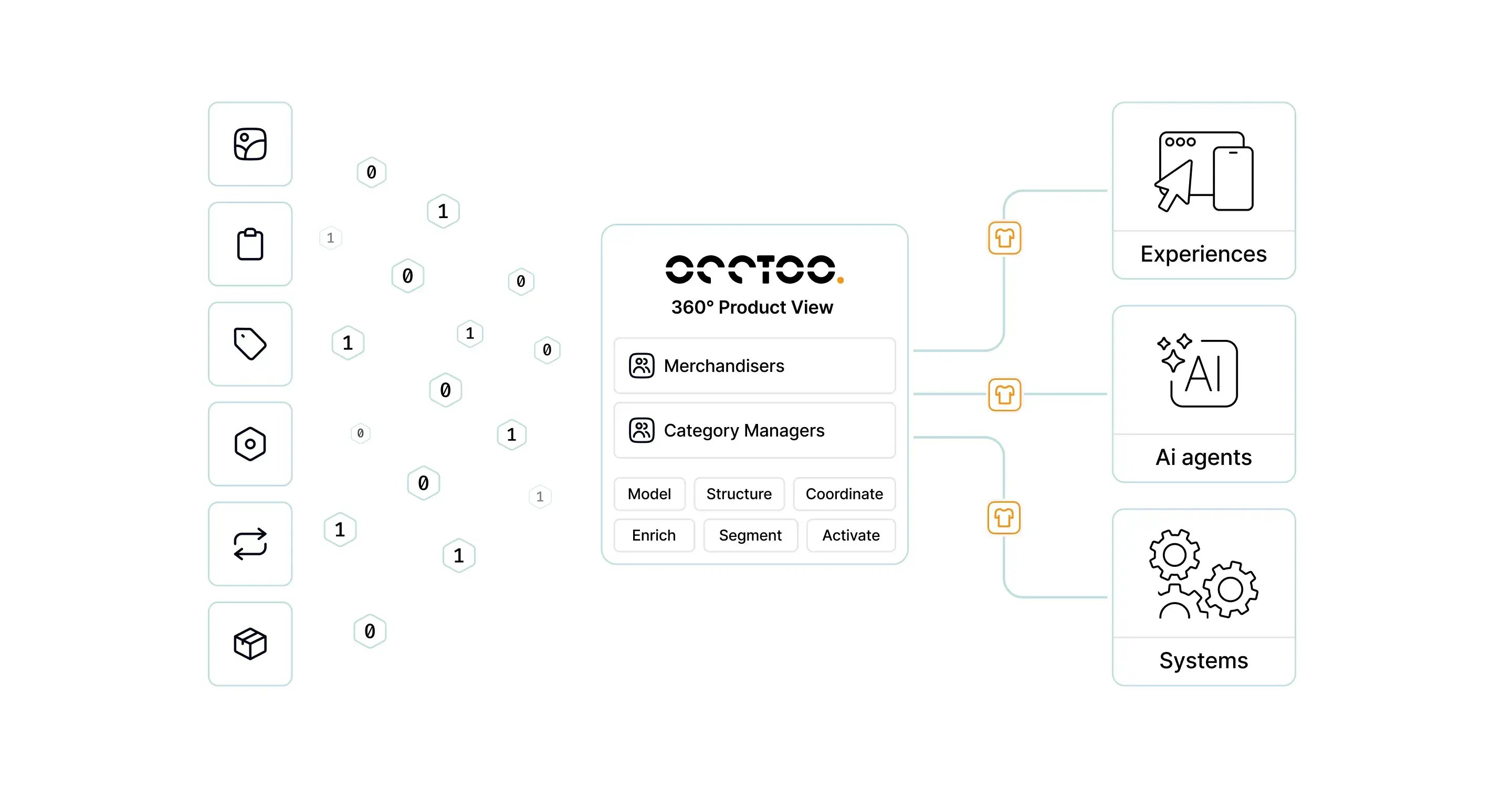
Instead of copying and storing data, Occtoo connects to the systems where data already lives and turns it into complete, consumable product feeds. These feeds can power product detail pages, campaigns, digital product passports, AI-driven experiences, and more.
Scale the product catalog without limits
Unlike a PIM, Occtoo has no practical data limits. There are no rigid models or bottlenecks but a powerful stream of product data flowing in real time. No matter how deep or wide your product data grows, Occtoo keeps up. It’s built to handle unlimited product data with high performance, even when serving high-traffic websites and real-time experiences.
Prepare product data for agentic commerce
AI agents are only as good as the data they’re grounded in. Occtoo delivers complete, structured product feeds through the MCP protocol, making your master product ready for any AI service or agent. Unlike a PIM, which holds a partial snapshot of product data, Occtoo provides AI agents with a full, up-to-date view of the master product on a silver platter, easy to consume.
Happy teams that move at full speed
Introduce product orchestration to your team, and they will cheer. That's a promise. In Occtoo, every role has access to the data they need to do their job. Teams can work in parallel with full transparency into what is shown where. Most importantly, state awareness reduces internal support, making it easier to set priorities and coordinate work across teams.
Read this interview with Nordic Nest's Master Data Specialist to learn how Occtoo's Product Orchestration Engine delivers control, speed and confidence.
Product data efficiency that pays off
With Occtoo, teams increase product throughput, reduce time to market, and gain full control over their data. Efficiency comes from orchestration, not integration. Occtoo streamlines the flow of product data across systems, enabling teams to reuse and repurpose data without heavy technical work.
| Perspective | Traditional PIM | Product Orchestration |
|---|---|---|
| Process | PIM is a tool for storing data. Manual enrichment, one product at a time. | POE is a process for orchestrating data. End-to-end transparency, working in parallel with product batches. |
| Data scope | Manages a defined set of data, only product content. | Handles all product-related data including media, customer, supplier and transactional data. |
| Scale & performance | Struggles with large datasets. | No data limits, no performance issues. |
| AI readiness | Not designed for AI. | Structured, rich data activated for AI. |
| Activation | Additional steps to publish the data. | Real-time multichannel activation. |
| Flexibility | Static setup that is difficult to change. | Flexible data model built for adapting to all digital initiatives. |
| Cost & ownership | Expensive vs value. | Efficiency gains, consolidation and lower integration costs. |
Who benefits from product orchestration?
Ecom teams Products stuck in onboarding. Slow time to market. Too much dependency on IT. Product orchestration gives ecom teams the control and speed to get products live without waiting on anyone else — from raw supplier file to live shoppable product.
Category managers: Poor supplier data. Manual Excel work. No control over article flow without IT. With Occtoo, category managers get a single command centre to clean, coordinate, and enrich product data, and the speed to act without waiting on anyone. No more Excel overload. The Product Onboarding App is the tool that finally keeps up with the way you work.
Merchandisers: Limited control over what is published where. Speed blocked by IT dependencies. Product data, pricing, inventory, and media scattered across systems. With Occtoo, merchandisers do not wait for data or developers. Search, segment, and activate from one workspace, and own the product experience from data to display.
IT and technical leaders: Too many systems that do not talk to each other. Expensive integration projects. A backlog that never gets shorter. Occtoo sits at the centre of a composable architecture, connecting everything, building the Master Product, activating it wherever it needs to go. A lot of infrastructure without doing a lot of work.
What product orchestration looks like in practice
Nelly.com replaced their entire commerce stack in five months with Occtoo at the centre. Their IT team went from 20 people to 4. They now run multiple campaigns per week using Occtoo Segments — fast, flexible, and without IT involvement.
Nordic Nest shortened lead times, launched more products, and maintained its highest quality standards without compromise.
"We want to shorten lead times, launch more products, and keep the highest quality. That's how we stay competitive. With Occtoo, we can do this, without compromise." — Edith Rehnberg, Master Data Specialist, Nordic Nest Group
Alligo went from waiting days on product data updates to hours. New use cases that previously took months to build can now be enabled in days.
Is your product data ready for AI agents?
Agentic commerce is not a future trend. It is happening now. AI assistants are already searching, comparing, and recommending products on behalf of buyers — before a human ever clicks.
Ask yourself:
- Do you have a single, trusted Master Product. Not just a PIM, but a unified view including pricing, media, supplier data, and brand context?
- Is your product data machine-understandable? Usage scenarios, certifications, sustainability attributes: the context AI agents need to recommend confidently.
- Can you activate your products via MCP protocol?
- Can you add a new channel without rebuilding your data layer from scratch?
If the answer to any of those is no, product orchestration is where to start.
Start orchestrating your product data
To tie this together: PIMs still have a place today. But if you want to set your product data free, eliminate the holes in your master product data, and deliver complete product feeds no matter how wide or tall you grow, orchestration is the way forward.